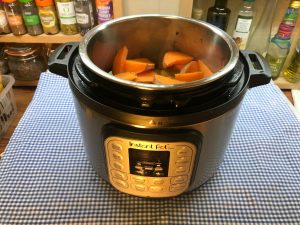
 If you want healthy meals that are ready in minutes yet retaining maximum nutrients and flavor, then the Instant Pot is the kitchen must-have for you.
I was both delighted and scared in equal measure whenever my brother cooked a meal in his traditional pressure cooker, because – although the food was delicious – I found the feeling that the cooker might explode at any moment a little unnerving.
This was the standard pressure cooker that must have graced a thousand kitchens in its heyday in the 1950s and beyond. But while it produced delicious food in record time there was always the constant fear lurking in the background that it might explode. Also it was tricky to master, relying on a number of blasts of the whistle which varied according to what was being cooked to signal when it was ready to release the pressure and serve.
So when those clever folks at Instant Pot reinvented the pressure cooker to make it ultra user-friendly, I was more than a little interested!
In May 2021, I bought my Instant Pot from Amazon and have used it more or less every day since. Most times I use it to cook chick peas or some other dried bean. It is lightening fast (Chickpeas in 30 minutes… Black Beans in 15) compared with other methods such as a slow cooker or saucepan and it is completely safe with no risk of the water boiling dry (as with a saucepan) because it has a bult-in timer and it also retains all the precious nutrients.
In fact, pressure cooking enhances the antioxidant value: compared with the traditional method of overnight soaking the beans and then boiling for 60 minutes (making sure you keep the water topped up!) cooking pre-soaked black beans in an Instant Pot for 15 minutes resulted in SIX times the antioxidant potential of the traditionally cooked beans.(See source 1 below). in addition, they taste great.
There are a number of models of Instant Pot and, although I only have the entry-level Duo-30 Mini with a capacity of three liters, you can even make yoghurt in it – try doing that with a traditional pressure cooker!
Research reveals steaming is the best cooking method for retaining maximum nutrients while opening up the cells of plants for maximum bioavailability (enabling your body to gain the maximum nutritional value from the food) while avoiding leaching out the nutrients which occurs with boiling, where much of the nutritional vale is poured away when you drain the beans, making the kitchen sink is the best fed member of the family.
What’s more, the shorter the cooking time the more nutrients are retained – despite the high temperature the food is cooked at. So the ‘Goldilocks’ sweet spot for maximum nutritional value is a combination of steaming and pressure cooking. And this can easily be achieved using a steamer basket in the Instant Pot.
The Duo-30 Mini Three liter Instant Pot shown here does not come with steamer basket, but Amazon can supply one.
So the procedure is to soak the beans, if instructed to do so on the packet and then put them in the steamer basket, select steam and adjust the timer as required. When the correct to had elapsed the device will make a gentle beeping sound (no dramtatic whistles here) at which point you can release the pressure and trun the device off. Once the steam has disapiated, you can open the lid and enjoy the delicious beans.
The exception to steaming chick peas is if you want to create some ‘Aquafaba’ This is a really valuable substance being a perfect vegan-friendly substitute for eggs in vegan cooking.
So valuable is it I have created this separate page detailing the many uses of aquafaba.
It is not only in cooking beans where the Instant Pot scores, but vegetables also retain far more nutrients and are far more bioavailable when you use this steaming/Instant Pot combo.
For delicate vegetables, such as broccoli (don’t forget to cut up the florets at lease 45 minutes begore you cook them to allow enough time for the maximum sulforaphane to be created), I set the timer to 1 minute. However, when the pressure builds up and the screen on the Instant Pot shows the pressure is fully built up and the minute of cooking at full pressure is about to start I immediately, release the pressure and open the lid as soon as it becomes unlocked. You’ll find that the broccoli is perfectly cooked. Other, more robust, r, vegetables such as kale need to be steamed for four minutes and sprouts for three. In each case release the pressure as soon as the timer hits zero signified by the letter ‘L’ appearing.
- Xu BJ, Chang SK. Total phenolic content and antioxidant properties of eclipse black beans (Phaseolus vulgaris L.) as affected by processing methods. J Food Sci. 2008;73(2):H19-27.
- Natella F, Belelli F, Ramberti A, et al. Microwave and traditional cooking methods: effect of cooking on antioxidant capacity and phenolic compounds content of seven vegetables. J. Food Biochem. 2010;34(4):796 – 810.
- Palermo M, Pellegrini N, Fogliano V. The effect of cooking on the phytochemical content of vegetables. J Sci Food Agric. 2014;94(6):1057-70.
- Vieites-Outes C, Lopez-Hernandez J, Lage-Yusty M. Modification of glucosinolates in turnip greens (Brassica rapa subsp. rapa L.) subjected to culinary heat processes. 2016;14(4)536-540.
- Yadav SK, Sehgal S. Effect of home processing on ascorbic acid and beta-carotene content of spinach (Spinacia oleracia) and amaranth (Amaranthus tricolor) leaves. Plant Foods Hum Nutr. 1995;47(2):125-31.